


Sculptra vs Fillers: Thailand Comparison Guide 2026
Quick Answer: Sculptra vs Fillers
Sculptra and dermal fillers are both injectable treatments used to address signs of aging, but they work in fundamentally different ways. Dermal fillers provide immediate volume and contour by physically filling areas of volume loss. Sculptra is a collagen biostimulator that gradually stimulates your body's natural collagen production over several months. For immediate correction of lips, cheeks, or jawlines, fillers are the preferred option. For gradual, long-term facial rejuvenation and collagen restoration, Sculptra is often recommended.
Sculptra vs Fillers at a Glance
Feature | Sculptra | Dermal Fillers |
Main ingredient | Poly-L-Lactic Acid (PLLA) | Hyaluronic Acid (HA) |
Category | Active biostimulator | Passive volumiser |
Results | Gradual — 4 to 12 weeks onset | Immediate — visible same day |
Primary purpose | Collagen stimulation | Volume replacement |
Best for | Overall facial rejuvenation, larger areas (cheeks, temples) | Targeted contouring (lips, chin, jawline, under-eye) |
Treatment sessions | Usually 2–3 sessions | Often a single session |
Longevity | Up to 2 years or longer | 6 – 18 months (area dependent) |
Reversible? | No | Yes — dissolved with hyaluronidase |
Suitable for lips / under-eye? | No — not recommended for these areas | Yes — the standard treatment for these areas |
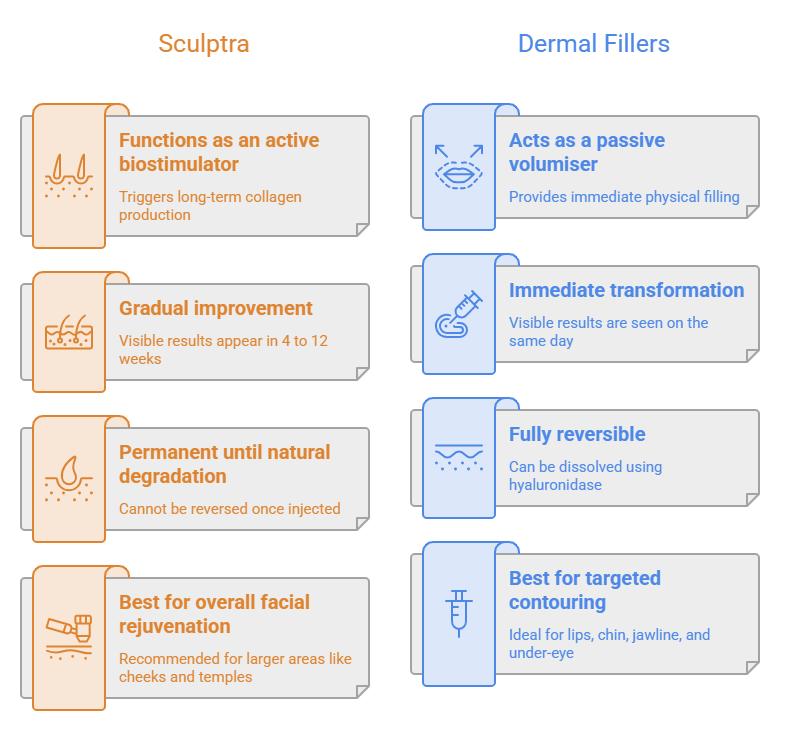
One of the biggest misconceptions is that Sculptra and fillers are direct substitutes. In reality, they solve different aging concerns. Many experienced aesthetic doctors use both treatments strategically to address volume loss, skin quality, and facial structure simultaneously.
What Is Sculptra?
Sculptra treatment in Bangkok is an injectable collagen biostimulator. It stimulates fibroblasts within the skin to produce new collagen over time.
As collagen gradually develops, patients may notice:
• Improved skin firmness
• Enhanced facial structure
• Better overall skin quality
• Reduced hollowing in the temples and cheeks
• More youthful, naturally contoured facial appearance
Unlike traditional fillers, Sculptra works beneath the skin to address one of the root causes of facial aging: collagen depletion, which declines by approximately 1% per year after the age of 25.
What Are Dermal Fillers?
Dermal fillers are injectable treatments used to restore lost volume, enhance facial features, and improve facial contours. One of the reasons dermal fillers are so popular is that results are typically visible immediately after treatment, making them a popular choice for patients seeking noticeable enhancement without surgery.
Fillers are commonly used for:
• Lip enhancement
• Cheek augmentation
• Jawline contouring
• Chin projection
• Nasolabial folds
• Marionette lines
• Under-eye hollows (tear trough)
Results are visible immediately after treatment, making fillers popular among patients seeking instant improvement before an event or occasion.
How Are Sculptra and Dermal Fillers Different?
Although both treatments are injectable and help address signs of aging, they work in very different ways.
Sculptra: Gradual Collagen Building
Sculptra works by encouraging your body to produce more of its own collagen. After the treatment, tiny PLLA particles stimulate collagen-producing cells beneath the skin. Over the following weeks and months, new collagen gradually develops, helping restore facial support, improve skin quality, and create natural-looking rejuvenation.
Because Sculptra relies on your body's collagen-building process, results appear gradually rather than immediately.
Think of Sculptra as helping your skin rebuild itself from within.
Sculptra vs Fillers: Which Lasts Longer?
One of the most common questions patients ask is: which lasts longer, Sculptra or fillers?
Longevity Comparison
Duration varies according to brand and clinic etcetc
Treatment | Typical Duration |
Sculptra | Up to 2 years or longer |
Lip fillers | 6 – 12 months |
Cheek fillers | 12 – 18 months |
Jawline fillers | 12 – 18 months |
Chin fillers | 12 – 18 months |
Nasolabial fold fillers | 12 – 18 months |
Why Sculptra Lasts Longer
Sculptra stimulates your own collagen production rather than relying solely on an injected gel. As new collagen develops, the skin continues to benefit from structural support even after the PLLA particles have been fully absorbed by the body.
Longevity varies between individuals. Factors such as age, metabolism, lifestyle, sun exposure, and treatment area can all influence how long results last for both Sculptra and fillers.
Which Treatment Looks More Natural?
Many patients worry about looking "overdone." The table below compares both treatments across the concerns patients raise most often.
Concern | Sculptra | Dermal Fillers |
Gradual, undetectable change | Excellent | Moderate |
Immediate improvement | Limited | Excellent |
Overall facial rejuvenation | Excellent | Good |
Structural contouring (lips, chin, jaw) | Moderate | Excellent |
Skin quality improvement | Excellent | Limited |
Patients seeking subtle, progressive improvement often prefer Sculptra because the results develop gradually. Friends and family may notice you look refreshed without identifying a specific cosmetic treatment.
Who Is a Good Candidate for Sculptra?
• ✅ Has age-related collagen loss
• ✅ Notices facial volume depletion across multiple areas
• ✅ Wants long-lasting improvement (up to 2 years or more)
• ✅ Prefers gradual, progressive enhancement over instant change
• ✅ Has mild to moderate skin laxity
Best Concerns for Sculptra |
Hollow temples |
General facial aging across multiple areas |
Skin thinning and reduced elasticity |
Mild to moderate facial sagging |
Overall collagen depletion (not isolated to one feature) |
Who Is a Good Candidate for Fillers?
• ✅ Wants immediate, visible results
• ✅ Needs targeted contouring in a specific area
• ✅ Wants lip enhancement or definition
• ✅ Wants jawline definition or chin projection
• ✅ Wants cheek volume or projection
Best Concerns for Fillers |
Thin lips needing volume or definition |
Weak or recessed chin |
Flat or deflated cheeks |
Undefined jawline |
Deep facial folds requiring immediate correction |
Under-eye hollowing (tear trough) |
Important note: Sculptra is not recommended for the lips or the under-eye (tear trough) area due to the risk of nodule formation in these thin-skinned, high-movement zones. Hyaluronic acid fillers remain the standard of care for both areas.
Can Sculptra and Fillers Be Combined?
Yes. In fact, many experienced aesthetic doctors combine both treatments as standard practice using Sculptra to treat the lateral parts of the face and improve overall skin quality, while using HA fillers for the central face (lips, jawline, chin, and under-eyes) where Sculptra is not recommended.
Combination Treatment Benefits
Goal | Recommended Approach |
Restore facial volume in lips, chin, under-eye | Fillers |
Improve overall skin quality and firmness | Sculptra |
Long-term collagen support | Sculptra |
Immediate contouring for an event or occasion | Fillers |
Comprehensive full-face rejuvenation | Combination — Sculptra for lateral/larger areas, fillers for central face |
Many patients also combine Sculptra and fillers with Botox for expression lines, or energy-based treatments such as Ultherapy for additional skin tightening. See our full Botox vs Fillers and Ultherapy vs HIFU comparison guides for more on combining treatment modalities.
Rather than viewing Sculptra vs fillers as an either-or decision, many practitioners use them together. Fillers provide immediate structure and contour, while Sculptra supports long-term collagen regeneration and skin quality improvement.
How Doctors Choose Between Sculptra and Fillers
Experienced injectors typically evaluate age-related volume loss, collagen depletion, skin quality, facial anatomy, treatment goals, and desired timeline before recommending a treatment plan.
Treatment Selection Guide
Goal | Best Option |
Immediate lip enhancement | Fillers |
Jawline contouring | Fillers |
Chin augmentation | Fillers |
Under-eye hollowing | Fillers |
Gradual facial rejuvenation | Sculptra |
Collagen restoration | Sculptra |
Skin firmness improvement | Sculptra |
Comprehensive anti-aging | Combination |
What Should You Consider Before Choosing Sculptra or Fillers?
When deciding between Sculptra and fillers, it's helpful to think about your goals, timeline, and expectations.

Why Choose The Cosmo Clinic for Sculptra or Fillers in Bangkok
The Cosmo Clinic is a licensed aesthetic medical clinic established in 2015, with three Bangkok locations: CentralPlaza Pinklao, The Mall Thapra, and CentralPlaza Rama 3.

• ✅ Licensed doctors - all treatments performed by qualified aesthetic doctors registered with the Medical Council of Thailand
• ✅ Authentic products - Sculptra (Galderma) and Thai FDA-approved fillers sourced through authorised distributors
• ✅ Personalised treatment planning - the right treatment, or combination, recommended through individual facial assessment
• ✅ Transparent pricing - full cost breakdown provided before any procedure begins
Not sure where to start? Read our guide on How to Choose a Filler Clinic or browse the Best Filler Clinics in Bangkok for a full comparison of providers.
Frequently Asked Questions
Is Sculptra better than fillers?
Neither treatment is universally better. Sculptra is ideal for collagen stimulation and long-term rejuvenation, while fillers provide immediate volume and contouring. The right choice depends on your specific concern and timeline.
Does Sculptra last longer than fillers?
Yes. Sculptra typically lasts up to two years or longer, while most fillers last between 6 and 18 months depending on the treatment area and product used.
Can Sculptra replace fillers?
Not entirely. Sculptra improves collagen production but does not provide the immediate structural support required for certain areas such as the lips, chin, or jawline. It is also not recommended for the under-eye area.
Which treatment is best for facial aging?
The answer depends on the cause of aging. Patients with generalised collagen loss may benefit from Sculptra, while those with localised volume loss often benefit from fillers. Many patients achieve the best results with a combination approach.
How soon will I see results?
Fillers provide immediate results, visible the same day. Sculptra develops gradually over 4 to 12 weeks as collagen production increases, with full results visible at 3 to 6 months.
Can Sculptra be used under the eyes or on the lips?
No. Sculptra is not recommended for the lips or under-eye (tear trough) area due to the risk of nodule formation in these thin-skinned, high-movement zones. Hyaluronic acid fillers remain the standard and recommended treatment for both areas.


